Babur’s Indian Campaigns: SSC CGL Notes 2026
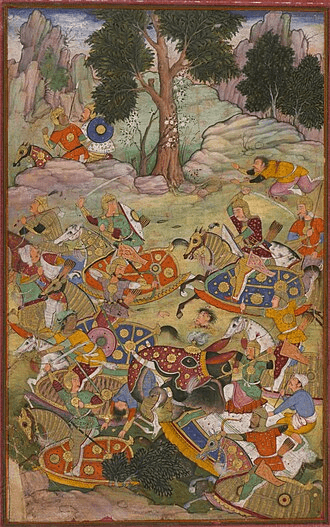
The battle of Panipat and the death of Sultan Ibrāhīm
Explore Babur’s Indian campaigns from Panipat to Ghaghra. Learn how the strategic use of Gunpowder Warfare in India defeated the Lodi and Rajput forces.
The transition of India from the Delhi Sultanate to the Mughal Empire was not a sudden accident but the result of the calculated military genius of Zahir-ud-din Babur. A descendant of Timur and Genghis Khan, Babur’s entry into the Indian subcontinent redefined medieval warfare. To understand the geopolitical shift of the 16th century, one must analyze the strategic depth of Babur’s Indian campaigns and the technological superiority he brought to the battlefield.
The Genesis of Babur’s Indian Campaigns (1519–1524)
Babur’s focus on India was born out of necessity. After losing his ancestral kingdom of Fergana and his beloved Samarkand multiple times, he established himself in Kabul in 1504. However, the limited resources of Afghanistan could not sustain his imperial ambitions.
Between 1519 and 1524, Babur conducted four preliminary expeditions into the Punjab region. These were not mere raids but reconnaissance missions designed to test the defenses of the Lodi Dynasty and the loyalty of local governors like Daulat Khan Lodi. During these early Babur’s Indian campaigns, he realized that the political climate of North India was fractured. The discontent of the Afghan nobility under Ibrahim Lodi provided the perfect opening for a full-scale invasion.
The Decisive First Battle of Panipat (1526)
The fifth expedition culminated in the First Battle of Panipat on April 21, 1526. This battle is a landmark in military history because it saw the first significant use of Gunpowder Warfare in India.
Military Tactics: Tulughma and Rumi
Babur was significantly outnumbered. Ibrahim Lodi commanded nearly 100,000 soldiers and 1,000 war elephants, while Babur had roughly 12,000 to 15,000 men. Babur overcame this disparity through two innovative tactics:
- Tulughma: A flanking maneuver where the army was divided into left, right, and center divisions to encircle the enemy.
- Araba (Rumi Tactic): Babur lashed 700 carts together with rawhide ropes to create a mobile defensive wall. Behind these carts, he stationed his matchlockmen and cannons, commanded by experts Ustad Ali and Mustafa.
The combination of concentrated artillery fire and the swift encirclement by the cavalry decimated the Lodi army. Ibrahim Lodi was killed on the battlefield, marking the end of the Delhi Sultanate and the successful commencement of the most famous of Babur’s Indian campaigns.
Countering Rajput Resistance: The Battle of Khanwa (1527)
Following the fall of Delhi, Babur faced a far more formidable foe: Rana Sanga of Mewar. Rana Sanga had organized a powerful confederacy of Rajput kings, posing a direct threat to the nascent Mughal state.
The Battle of Khanwa (March 17, 1527) was fought near Agra. To boost the morale of his terrified troops, Babur declared the conflict a Jihad and famously broke his wine vessels, vowing never to drink again. Despite the Rajput valor, Gunpowder Warfare in India once again proved decisive. The Mughal cannons broke the charge of the Rajput elephants and cavalry. The defeat of Rana Sanga effectively eliminated the only power capable of contesting Babur’s supremacy in North India.
Consolidating the East: Chanderi and Ghaghra (1528–1529)
To secure his flanks, Babur turned his attention to the remaining pockets of resistance.
- Battle of Chanderi (1528): Babur captured the strategic fort of Chanderi from Medini Rai, a close ally of Rana Sanga. This victory consolidated his hold over the Malwa region.
- Battle of Ghaghra (1529): This was the final major engagement of Babur’s Indian campaigns. Fought against the joint forces of the Afghans of Bihar and Bengal under Mahmud Lodi, this battle was unique as it was fought both on land and water (on the banks of the Ghaghra River).
Babur’s use of synchronized naval and land artillery ensured a victory that secured the eastern frontiers of his empire, stretching from the Oxus to the borders of Bengal.
Summary of Babur’s Major Military Campaigns (1526–1529)
This table summarizes the four pivotal battles that transitioned North India from the Lodi Sultanate to Mughal rule.
| Year | Battle | Opponent | Key Military Feature | Outcome & Significance |
| 1526 | First Battle of Panipat | Ibrahim Lodi (Delhi Sultanate) | First major use of cannons and Tulughma tactics in India. | Decisive victory; death of Ibrahim Lodi; end of the Delhi Sultanate. |
| 1527 | Battle of Khanwa | Rana Sanga (Rajput Confederacy) | Use of Araba (cart) formation; declared a Jihad to boost morale. | Defeat of the powerful Rajput confederacy; solidified Mughal presence. |
| 1528 | Battle of Chanderi | Medini Rai (Rajput Chief) | Siege warfare; psychological impact through the “Jauhar” of Rajput women. | Secured the Malwa region; broke the remaining Rajput resistance. |
| 1529 | Battle of Ghaghra | Mahmud Lodi & Nusrat Shah (Afghans) | Rare amphibious battle fought on both land and the river banks. | Final blow to Afghan power in Bihar/Bengal; secured the eastern frontier. |
Tactical Innovations: Why Babur Won
- Artillery (Topkhana): Under the command of Ustad Ali and Mustafa, Babur’s artillery created panic among enemy elephants, causing them to trample their own soldiers.
- Cavalry Mobility: The Central Asian light cavalry was far more maneuverable than the slow-moving heavy infantry and elephant corps of the Indian rulers.
- Coordination: Unlike the fractured command of the Lodi and Rajput armies, Babur maintained a disciplined, centralized command structure.
The Legacy of Gunpowder Warfare in India
Babur’s success was not just about courage; it was about technical evolution. Before his arrival, Indian warfare relied heavily on the sheer mass of infantry and the shock value of elephants. By introducing Gunpowder Warfare in India, Babur shifted the focus to mobility, coordination, and firepower.
- Artillery Integration: He was the first to successfully integrate heavy siege guns with highly mobile light cavalry.
- Engineering: His use of defensive structures (like the Araba) allowed a smaller force to withstand and repel much larger armies.
Conclusion: The Architect of a New Era
Babur died in 1530, just four years after Panipat. While he did not have time to establish a complex administrative machinery like his grandson Akbar, his military successes laid the foundation. Babur’s Indian campaigns broke the stagnant military traditions of the Sultanate era and introduced a centralized, technologically advanced form of monarchy. Through the strategic application of Gunpowder Warfare in India, he ensured that the house of Timur would rule the subcontinent for over two centuries.
Tagged with

Written by Abhay Raj Patel
Passionate writer sharing thoughts on life, technology, and everything in between.