The Maratha Kingdom: Sovereignty, Military Innovation, and Political Legacy
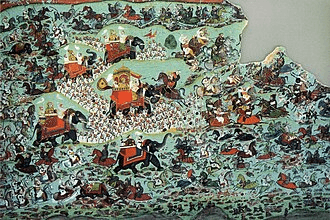
Maratha Kingdom
The Maratha Kingdom, which later evolved into a vast confederacy, represents one of the most formidable challenges to Mughal hegemony
The Maratha Kingdom, which later evolved into a vast confederacy, represents one of the most formidable challenges to Mughal hegemony in 17th and 18th-century India. Founded by Chhatrapati Shivaji Maharaj, the Marathas shifted the political center of gravity from the North to the Deccan, introducing revolutionary concepts in administrative transparency and guerrilla warfare.
1. The Foundation: Chhatrapati Shivaji Maharaj (1674–1680)
The rise of the Maratha kingdom was a response to the oppressive policies of the Bijapur Sultanate and the Mughal Empire. Shivaji Maharaj utilized the rugged terrain of the Western Ghats to develop Ganimi Kava (Guerrilla Warfare). His coronation in 1674 at Raigad Fort marked the formal birth of the Swarajya (Self-Rule).
Also Read: Babur’s Indian Campaigns
The Ashta Pradhan Council
Shivaji did not rule as an autocrat; he established a council of eight ministers to ensure specialized governance.6
| Designation | Title | Primary Responsibility |
| Peshwa | Prime Minister | General administration and state welfare. |
| Amatya | Finance Minister | Maintaining state accounts and taxes. |
| Sachiv | Secretary | Managing royal correspondence. |
| Sumant | Foreign Minister | Dealing with foreign states and dignitaries. |
| Senapati | Commander-in-Chief | Military organization and recruitment. |
| Nyayadhish | Chief Justice | Civil and military justice. |
| Panditrao | High Priest | Religious matters and charities. |
| Mantri | Intelligence | Internal security and daily proceedings. |
2. Revenue and Military Administration in Maratha Kingdom
The economic stability of the Maratha state was built on a disciplined revenue system. Unlike the Mughal system, which often relied on intermediaries, Shivaji preferred direct contact with the peasantry.
Taxation: Chauth and Sardeshmukhi
To fund the standing army and expansion, two specific taxes were levied on non-Maratha territories:
- Chauth: 1/4th (25%) of the land revenue paid to the Marathas to ensure protection against third-party invasions.
- Sardeshmukhi: An additional 10% levy based on Shivaji’s claim as the hereditary head (Sardeshmukh) of the region.
Naval Supremacy
Shivaji is often called the “Father of Indian Navy.” He recognized that controlling the Konkan coast was vital to counter the Dutch, English, Portuguese, and Siddis. He built strong sea forts like Sindhudurg and Vijaydurg and maintained a fleet of small, maneuverable ships.
3. The Period of Struggle (1680–1707)
Following Shivaji’s death, the empire faced its greatest existential threat during the 27-year Mughal-Maratha War.
- Chhatrapati Sambhaji: Captured and executed by Aurangzeb in 1689, his martyrdom galvanized the Marathas.
- Chhatrapati Rajaram: Led the resistance from Jinji Fort in the South.
- Tarabai: After Rajaram’s death, his widow Tarabai took command, successfully resisting the Mughal forces until Aurangzeb’s death in 1707.
4. The Era of the Peshwas (1713–1818)
The power shifted from the Chhatrapati to the Peshwa (Prime Minister) during the reign of Shahu Maharaj. Under the Peshwas, the Maratha state transformed into a Confederacy.
The Five Great Maratha Kingdom Houses
As the empire expanded, power was decentralized among five primary families:
| House | Region | Seat of Power |
| Peshwa | Maharashtra | Pune |
| Gaekwad | Gujarat | Baroda |
| Scindia (Shinde) | Malwa/Gwalior | Gwalior |
| Holkar | Malwa/Indore | Indore |
| Bhonsle | Vidarbha | Nagpur |
Peshwa Baji Rao I (1720–1740)
Baji Rao I is considered the greatest cavalry commander in Indian history. He championed the policy of “Northward Expansion,” aiming to plant the Maratha flag on the walls of Attock. His victory at the Battle of Palkhed (1728) against the Nizam of Hyderabad remains a textbook example of mobile warfare.
5. The Third Battle of Panipat (1761)
The expansion reached its zenith in the mid-18th century but faced a catastrophic setback at Panipat.23 The Maratha army, led by Sadashivrao Bhau, clashed with the Afghan forces of Ahmad Shah Abdali.24
- Cause: Conflict over the control of Delhi and the Punjab.
- Result: A pyrrhic victory for Abdali. While the Marathas lost nearly 70,000 soldiers, the Afghans were so exhausted they never returned to India, leaving a power vacuum eventually filled by the British.
6. Decline and British Conflict
The decentralization of the Confederacy led to internal rivalries. The British East India Company exploited these fractures through the Anglo-Maratha Wars.
- First Anglo-Maratha War (1775–1782): Ended with the Treaty of Salbai; Marathas remained dominant.
- Second Anglo-Maratha War (1803–1805): Scindia and Bhonsle forces were defeated; the British gained control of Delhi.
- Third Anglo-Maratha War (1817–1818): Final defeat of Peshwa Baji Rao II. The Peshwaship was abolished, and the Maratha territories were annexed into the Bombay Presidency.
7. Conclusion
The Maratha Empire’s legacy lies in its resistance to foreign domination and its administrative innovations. They were the last great indigenous power to hold sway over the Indian subcontinent before the British Raj. Their emphasis on fortification, naval power, and a professional standing army remains a significant chapter in Indian military history.
Key Takeaways for Competitive Exams (SSC/RRB)
- Founder: Shivaji Maharaj (Coronated 1674).
- Revenue: Chauth (25%) and Sardeshmukhi (10%).
- Council: Ashta Pradhan.
- Greatest Peshwa: Baji Rao I (Never lost a battle).
- Turning Point: Third Battle of Panipat (1761).

Written by Abhay Raj Patel
Passionate writer sharing thoughts on life, technology, and everything in between.